

 ENG
ENG
 English
 Español
Message Feedback

Industry News
Jun 09,2026
Straight Razor Handle for Beginners: How to Choose the Right One
Content
- 1 Why the Handle Is the First Decision Every Beginner Gets Wrong
- 2 What a Straight Razor Handle Actually Does
- 3 Handle Materials Compared: What Works Best for Beginners
- 4 Steel Handles: Why Beginners Should Take Them Seriously
- 5 How Handle Weight and Grip Affect Your First Shave
- 6 Wet Shaving vs. Dry Shaving: Does Handle Design Change?
- 7 Travel-Friendly Straight Razor Handles: What to Look For
- 8 How to Source a Quality Straight Razor Handle
Why the Handle Is the First Decision Every Beginner Gets Wrong
Most people picking up a straight razor for the first time spend weeks researching blade steel, grind types, and edge geometry. The handle? An afterthought. It ships with the razor, so it must be fine.
That logic leads to a lot of frustrating first shaves. The handle — also called the scales — controls how the blade sits in your hand, how much pressure you apply, and whether you can hold a consistent angle across your jaw, chin, and upper lip. For a beginner still building muscle memory, these things matter more than they do for an experienced shaver who can compensate instinctively.
The global wet shave market exceeded USD 19 billion in 2024 and continues to grow as more shavers move toward traditional, single-blade tools. A large part of that shift is driven by people discovering that the right equipment — handle included — makes the learning curve far more manageable.
What a Straight Razor Handle Actually Does
The handle of a straight razor serves three practical functions that most beginners don't think about until something goes wrong.
First, it houses and protects the blade. When the razor is closed, the blade folds inside the scales. A well-fitted handle keeps the blade aligned and prevents accidental contact when you're reaching into a shaving bag or setting it down on a wet counter.
Second, it creates balance. The pivot pin — where the blade and handle meet — is the center of balance for the whole razor. A handle that is too light or too heavy shifts that balance point and forces your wrist to compensate, which leads to uneven pressure and inconsistent angles.
Third, it gives you grip. A wet bathroom, soap-covered hands, and a razor-sharp blade is not a combination that rewards a slippery handle. Texture, material, and handle width all affect how securely you can hold the razor when your grip is less than ideal.
Handle Materials Compared: What Works Best for Beginners
Straight razor handles are made from a range of materials, each with different characteristics in weight, durability, grip, and maintenance requirements. Here is how the most common options compare for someone starting out.
| Material | Weight | Grip (Wet Hands) | Durability | Maintenance | Beginner Suitability |
|---|---|---|---|---|---|
| Wood | Medium | Good (dry), poor (wet) | Moderate | High — avoid prolonged moisture | Moderate |
| Plastic / Resin | Light | Moderate | High | Low | Good |
| Stainless Steel | Medium-Heavy | Excellent (textured) | Very High | Very Low | Excellent |
| Horn / Bone | Medium | Good | Moderate | Medium | Moderate |
| Carbon Fiber | Very Light | Moderate | High | Low | Moderate |
Wood handles have a classic look and a warm feel in the hand, but they require careful drying after every use. Left in a damp environment, the wood can warp, crack, or cause corrosion at the pivot pin. For a beginner who is still building a consistent post-shave routine, that extra maintenance step is easy to skip.
Plastic and resin handles are lightweight, easy to clean, and forgiving — a reasonable starting point, but they can feel insubstantial and offer less feedback through the hand during shaving.
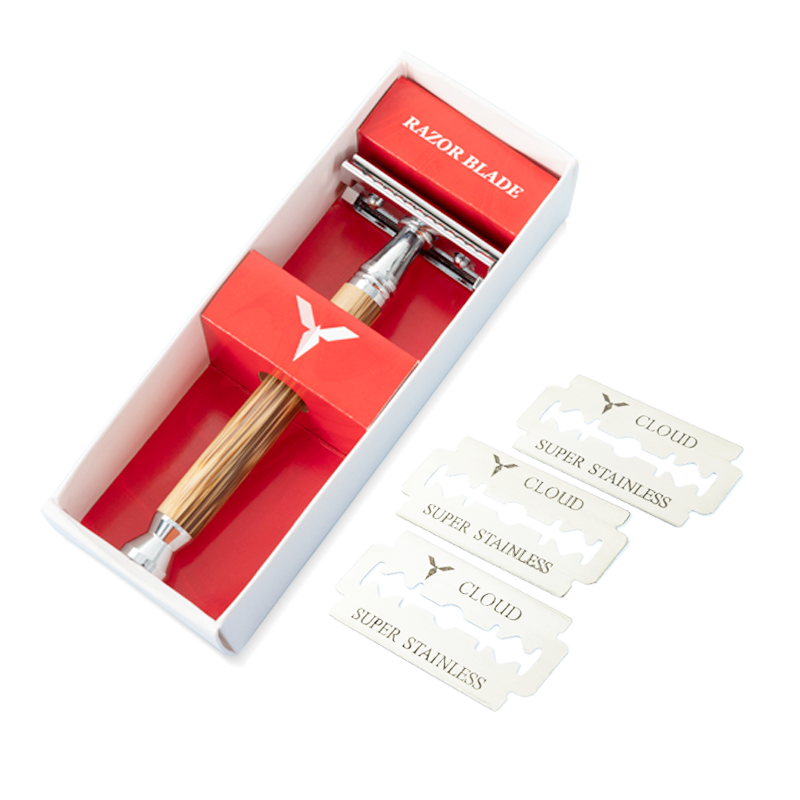
Stainless steel handles offer the best combination of durability, grip, and long-term value for beginners willing to invest in something they won't need to replace.
Steel Handles: Why Beginners Should Take Them Seriously
Steel gets overlooked in beginner guides because it is associated with heavier, more "advanced" razors. That reputation is outdated.
Modern high-quality straight razor handles for wet and dry shaving made from imported stainless steel are precision-machined to specific weight and balance targets, not just assembled from whatever metal is available. The result is a handle that feels deliberate in the hand rather than accidental.
For beginners, the key advantage is tactile feedback. A steel handle transmits more information through your grip — you can feel when the blade is correctly angled against your skin, and you can feel when pressure starts to creep up. That feedback loop accelerates learning in a way that lighter plastic handles simply don't.
Steel is also the most practical material for a shaving environment. It doesn't absorb water, doesn't warp, doesn't crack, and doesn't react poorly to shaving soap residue. A quick rinse and dry is all the maintenance required — which is the right level of effort for someone still focused on mastering technique.
Customization is another underrated benefit. Steel handles can be machined, finished, and coated in ways that wood and plastic cannot, which is why manufacturers offering custom or OEM configurations almost always work in steel as their primary material.
How Handle Weight and Grip Affect Your First Shave
Two beginners using identical blades can have completely different experiences depending on handle weight. This is not about preference — it is about physics.
A heavier handle shifts the balance point of the razor toward the back, which reduces the amount of wrist movement needed to guide the blade. For someone still figuring out how to hold a 30-degree angle consistently, less required movement means fewer mistakes. Ergonomic handle designs that account for this balance equation have become one of the primary innovation drivers in the wet shave market, precisely because they measurably improve the shaving experience for new users.
Grip surface matters just as much as weight. A smooth handle becomes unpredictable with wet, soapy hands. Textured surfaces — whether machined grooves, knurling, or a dual-surface design — give your fingers something to register against, so you're not white-knuckling the razor to compensate for a slippery grip.
A practical test: hold the razor at a relaxed grip. If your thumb and fingers feel like they're working to keep it from shifting, the handle isn't working for you. A well-designed handle should feel stable with minimal grip pressure.
Wet Shaving vs. Dry Shaving: Does Handle Design Change?
Straight razor shaving is almost always wet shaving — lather on the face, pre-softened skin, and a post-shave rinse. But the handle's material behaves differently depending on how much moisture is involved, and beginners who travel or shave in varied conditions should factor this in.
Wood handles are the most moisture-sensitive. Oak, chestnut, and red cedar are particularly prone to accelerating corrosion at the metal pivot pin when they stay damp. If you shave in a humid climate or tend to leave your razor on a wet counter, wood requires more attention than it's worth at the start.
Steel handles have no such limitation. They perform identically in wet and dry conditions, which makes them genuinely versatile for anyone using a precision-engineered double edge razor blade in combination with traditional wet shaving prep or a simpler dry routine.
If you shave more than five times a week, the cumulative moisture exposure on a wood handle adds up fast. Steel eliminates that variable entirely.
Travel-Friendly Straight Razor Handles: What to Look For
A straight razor that shaves beautifully at home can become a liability in a carry-on bag or a hotel bathroom. Handle design plays a significant role in how well a razor travels.
The two things that matter most for travel are compactness and durability under impact. Wood handles can chip or crack if the razor is jostled in a bag. Resin handles are more forgiving but can still scratch or mark. Steel handles absorb impact without surface damage and maintain their finish across hundreds of trips.
A handle with a slightly shorter scale length packs more easily without compromising grip during use. Dual-surface handle configurations — where the inner face is smooth for a clean aesthetic and the outer face is textured for grip — offer practical advantages in travel situations where you may be shaving quickly or with less setup than you'd have at home.
If portability is a priority, look for handles designed with a secure pivot pin that won't loosen with repeated opening and closing, and a material that can handle the humidity swings between air-conditioned flights and warmer destinations.
How to Source a Quality Straight Razor Handle
For individual shavers, sourcing a quality handle means looking beyond the razor's overall price point and evaluating the handle specifically. A razor sold at a premium doesn't automatically have a premium handle — and a mid-priced razor with a well-engineered steel handle will outperform an expensive razor with a poorly balanced scale every time.
Key questions to ask before buying:
What material is the handle made from, and what grade of that material?
Is the handle weight specified, and does the manufacturer explain the balance design?
What is the pivot pin construction — and can it be maintained if it loosens over time?
Is the handle available in multiple configurations, or is it a single fixed design?
For buyers sourcing handles at volume — barber supply companies, grooming brands, or private-label operators — the manufacturing origin of the handle matters more than the retail packaging around it. Handles made from imported high-quality steel on precision-machined production lines hold tighter tolerances than those produced on general-purpose equipment, which translates directly to consistent weight, fit, and finish across batches.
Shanghai Cloud Blade Manufacturing has produced razor blades and handles since 1997, with ISO9001-certified quality control and dedicated production lines for straight razor handles across multiple configurations. Explore Cloud's full shaving and grooming product range to find handle options suited to both personal and professional use.
Related Products
Looking for a Reliable Blade?
Work with a Manufacturer.
Inquiry Us Now

-
 +86-400 9915 887
 -
 +86-021-57644936
 -
 [email protected]
 -
 No. 2066, Yushu Road, Songjiang District, Shanghai, China
QUICK LINKS
 Home
HomePRODUCTS
QR CODE
Copyright © 2025 Shanghai Cloud Blade Manufacturing Co., Ltd. All rights reserved.
 Custom Double Razor Blade Factory
