

 ENG
ENG
 English
 Español
Message Feedback

Industry News
Mar 12,2026
How to Choose the Right Single Edge Razor Blade
Choosing the right single edge razor blade comes down to matching three factors to your specific task: blade material (carbon steel vs. stainless steel), thickness and rigidity, and edge coating or treatment. For precision scraping and glass cleaning, a standard 0.009-inch carbon steel blade with a honed edge delivers maximum sharpness. For wet or humid environments, a coated stainless steel blade resists corrosion and lasts longer. For industrial cutting tasks requiring durability over ultimate sharpness, a thicker high-carbon blade holds its edge under pressure. Getting these three factors right eliminates the frustration of blades that dull too fast, scratch delicate surfaces, or rust in storage.
Content
- 1 What Single Edge Razor Blades Are Used For
- 2 Blade Material: Carbon Steel vs. Stainless Steel
- 3 Blade Thickness and Rigidity: Matching Stiffness to the Task
- 4 Edge Coatings and Treatments: What They Do and When They Matter
- 5 Single Edge Blade Sizes and Formats: Industrial vs. Standard vs. Specialty
- 6 Choosing by Application: A Practical Guide
- 7 How Often to Replace a Single Edge Razor Blade
- 8 Safe Handling and Storage of Single Edge Razor Blades
What Single Edge Razor Blades Are Used For
Single edge razor blades are utility cutting and scraping tools distinct from double edge shaving blades. They have one sharpened cutting edge and a reinforced or folded spine on the opposite side that provides rigidity and safe handling. While they originated in straight razor and box-cutter applications, modern single edge blades serve a broad range of professional and consumer tasks — and each task has different blade requirements.
- Glass and surface scraping: Removing paint, adhesive residue, labels, silicone sealant, and debris from glass, ceramic tile, and smooth hard surfaces. Requires maximum sharpness and a thin profile to work under dried material.
- Hobby and craft cutting: Precision cutting of paper, card, film, balsa wood, foam, and thin sheet materials in modeling, scrapbooking, and graphic arts. Sharpness and blade flexibility determine cut quality.
- Trimming and detail work: Deburring, trimming gaskets, cutting caulk beads, shaping putty, and cleaning up edges in automotive bodywork and home improvement. Durability matters more here than ultimate edge sharpness.
- Medical and laboratory use: Tissue preparation, sample sectioning, and controlled dissection in research and veterinary contexts. Sterile packaging and consistent edge geometry are the primary requirements.
- Traditional straight razor shaving: Some single edge blades are used in shavette-style razors or specific vintage straight razor holders. Shaving requires the finest possible edge, optimized spine thickness for the specific holder, and ideally a platinum or chrome coating.
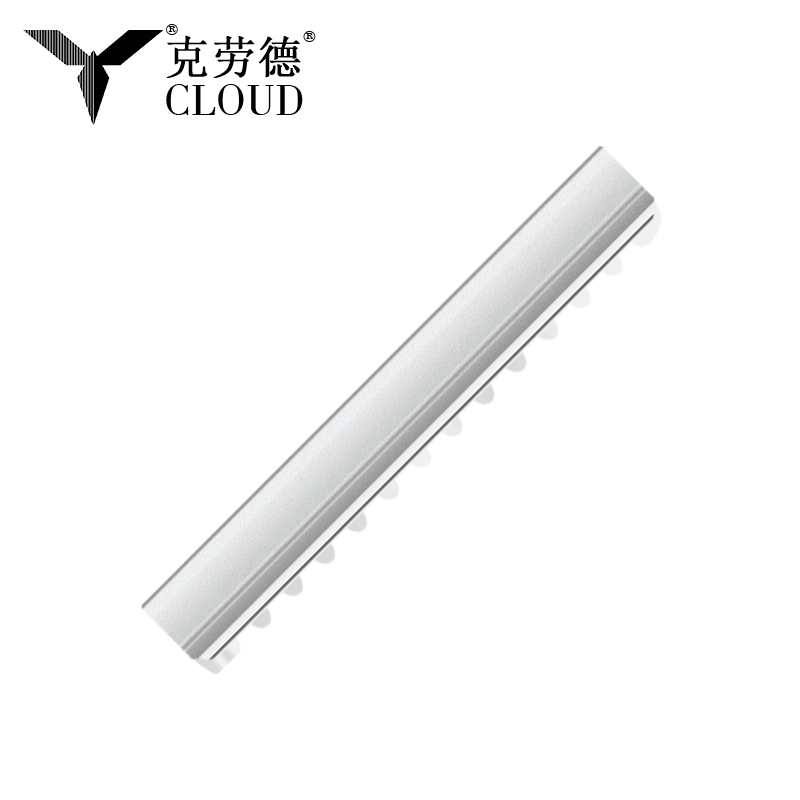
Blade Material: Carbon Steel vs. Stainless Steel
Material is the most consequential blade specification. Carbon steel and stainless steel blades have fundamentally different hardness, edge retention, and corrosion behavior that make each better suited to specific use environments.
Carbon Steel Blades
High-carbon steel can be hardened to Rockwell C hardness of 60–65 HRC, significantly harder than most stainless steels at equivalent thickness. This hardness allows carbon steel blades to be ground to a thinner, more acute edge geometry that cuts with less resistance and produces cleaner cuts in delicate materials. Carbon steel blades are the standard choice for glass scraping, precision hobby work, and any application where absolute sharpness is the priority.
The trade-off is corrosion susceptibility. Uncoated carbon steel blades begin oxidizing within hours in humid conditions and will develop rust spots that contaminate work surfaces and accelerate edge dulling. Carbon steel blades must be stored dry, used promptly after opening, and discarded rather than stored once used in wet conditions.
Stainless Steel Blades
Stainless steel blades — typically made from 440C, 420HC, or similar martensitic stainless alloys — achieve hardness of 55–58 HRC, somewhat lower than high-carbon steel, resulting in an edge that is slightly less acute and dulls marginally faster under identical use conditions. However, their corrosion resistance is dramatically better. Stainless blades can be rinsed, stored in humid environments, and used in wet applications without rust damage.
For general-purpose use, cleaning applications, and any situation where blades may be exposed to moisture or stored between uses over days or weeks, stainless steel is the practical choice for most users despite the marginal sharpness trade-off.
| Property | Carbon Steel | Stainless Steel |
|---|---|---|
| Typical hardness | 60–65 HRC | 55–58 HRC |
| Initial sharpness | Excellent | Very Good |
| Edge retention | Good | Good–Very Good |
| Corrosion resistance | Poor (rust-prone) | Excellent |
| Best environment | Dry, immediate use | Wet, humid, stored use |
| Relative cost | Lower | Slightly higher |
Blade Thickness and Rigidity: Matching Stiffness to the Task
Single edge razor blades are not all the same thickness. Standard utility blades — the type used in scraper holders for glass and surface cleaning — are typically 0.009 inches (0.23 mm) thick. Heavy-duty industrial variants run to 0.012–0.016 inches (0.30–0.41 mm), providing greater rigidity for prying, scraping hard materials, and applications where the blade must resist flexing under lateral load.
Standard Thickness (0.009 in / 0.23 mm)
Standard thickness blades are the most versatile and widely compatible with commercially available single edge blade holders, scrapers, and utility handles. Their slight flexibility allows them to conform to minor surface irregularities during scraping — which can be an advantage on curved glass or uneven surfaces. However, they can flex or chatter when used with high lateral force, which reduces scraping efficiency and can leave uneven results.
Heavy Duty Thickness (0.012–0.016 in)
Thicker blades resist flex and chatter under high scraping force, making them better for removing thick paint coatings, stubborn adhesive, and hardened caulk. The stiffer blade transmits force more directly to the material being removed rather than absorbing it in flex. The trade-off is a slightly blunter edge geometry — the same grinding angle on a thicker blade produces a slightly wider bevel — and heavier blades may not fit all standard single-edge holders. Always verify holder compatibility before purchasing heavy duty variants.
Thin Flexible Blades for Precision Cutting
Some specialty single edge blades for hobby and craft use are produced thinner than standard — as thin as 0.006–0.007 inches — to maximize flexibility for curved cuts and minimize the material disruption around a cut line. These are not interchangeable with standard scraper blades and are designed for specific holder systems used in model-making and graphic arts.
Edge Coatings and Treatments: What They Do and When They Matter
Most quality single edge razor blades carry one or more edge treatments beyond basic grinding. These coatings affect initial sharpness, lubrication during cutting or shaving, corrosion resistance at the edge itself, and how long the blade performs before noticeable dulling. Understanding what each coating offers helps justify paying more for treated blades in applications where it matters.
PTFE (Teflon) Coating
PTFE coating is applied as a thin polymer layer over the ground blade edge, reducing the friction coefficient between the blade and the material being cut or the skin being shaved. The coating is typically 0.5–2 micrometers thick — thin enough to preserve edge geometry while providing measurably lower drag. PTFE-coated blades glide more smoothly across glass surfaces during scraping, reducing the squealing sound and hand fatigue associated with dry steel-on-glass contact. For shaving applications, PTFE coating reduces skin drag significantly, which is why virtually all premium shaving blades carry it.
Chromium Coating
Chromium hard coating adds surface hardness to the blade edge — hard chrome reaches 65–72 HRC equivalent surface hardness — which reduces the rate at which the edge deforms under use. Chrome-coated blades stay sharper for more cycles of use on abrasive or dense materials. They also provide corrosion protection at the edge, where uncoated carbon steel is most vulnerable to rust initiation from moisture exposure during use.
Platinum Coating
Platinum edge coating is primarily found on premium shaving blades and combines extreme hardness with biocompatibility and corrosion resistance. Platinum-coated blades are among the sharpest and smoothest-cutting available and are the specification for medical-grade laboratory blades used in tissue sectioning. For industrial scraping and cutting, platinum coating offers no practical advantage over chromium at significantly higher cost and is only worth specifying for shaving or precision medical use.
Wax or Oil Protective Coating
Some utility-grade single edge blades are supplied with a light mineral oil or wax coating across the entire blade surface — not just the edge — as a rust inhibitor during storage. This is a packaging protection, not a performance enhancement. The coating should be wiped off before use on surfaces where oil contamination would be a problem (such as glass surfaces being prepared for film or coating application).
Single Edge Blade Sizes and Formats: Industrial vs. Standard vs. Specialty
Single edge razor blades are not a single standardized product — they exist in several size formats designed for specific holder systems and applications. Buying the wrong format results in a blade that does not fit the intended handle or holder, which is one of the most common purchasing mistakes.
| Format | Approx. Width | Approx. Length | Typical Use |
|---|---|---|---|
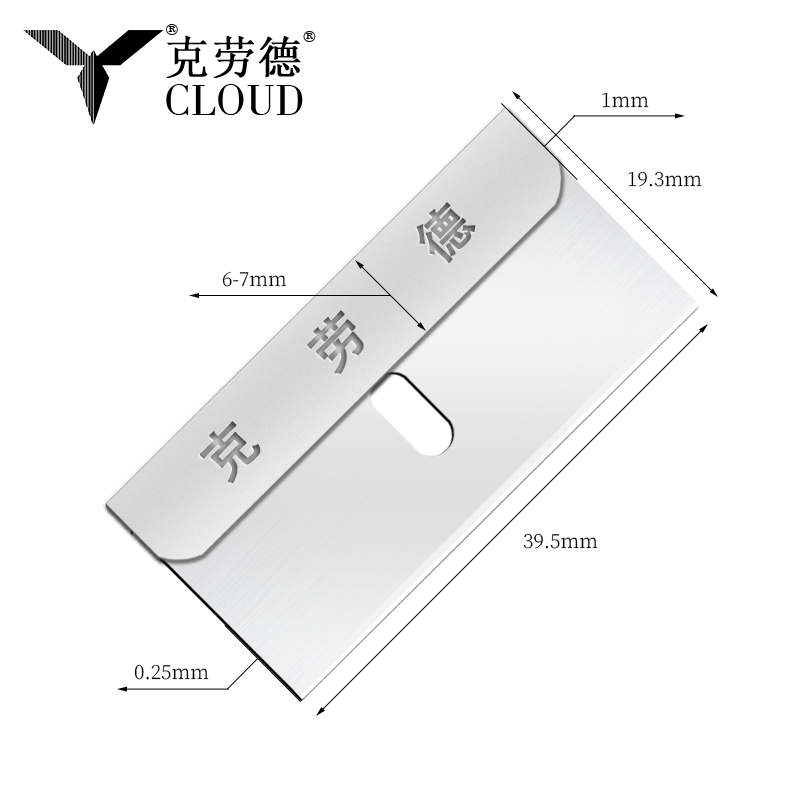
| Standard utility / scraper | 22 mm (7/8 in) | 38 mm (1.5 in) | Glass scraping, general purpose |
| Wide industrial scraper | 38–50 mm | 50–75 mm | Large area paint/adhesive removal |
| Injector / shaving format | 19 mm | 38 mm | Injector-style shaving razors |
| Hobby / #11 style | 6–8 mm | 35–40 mm | Craft knife, model making |
| Microtome / lab blade | Variable | 80–260 mm | Tissue sectioning, laboratory |
For the vast majority of household and professional scraping tasks, the standard 22 × 38 mm utility format is the correct choice and fits virtually all commercially available single-edge blade holders and window scraper tools. Confirm your holder's blade slot dimensions before ordering wide industrial blades, as not all industrial holders are interchangeable.
Choosing by Application: A Practical Guide
Rather than selecting a blade in the abstract, matching blade specifications directly to the task produces the best results with the least cost. The following recommendations cover the most common single edge blade applications with specific guidance on what to prioritize.
Glass and Window Cleaning / Paint Removal
For removing dried paint overspray, adhesive labels, stickers, tape residue, and mineral deposits from glass surfaces, use a standard thickness (0.009 in) carbon steel blade with PTFE coating. The PTFE reduces glass surface friction and the scratching sound that indicates the blade is working against rather than under the material. Always use with a proper scraper holder — never hold a bare blade directly, as this creates injury risk and reduces scraping control. Work with the blade at a shallow angle (15–30°) to maximize the undercutting action. Replace blades frequently — a dull blade requires more pressure and dramatically increases the risk of scratching the glass surface.
Hobby, Craft, and Model Making
For precision cutting of card, film, balsa, and foam, prioritize sharpness over durability. Carbon steel craft blades (hobby #11 format or similar) provide the finest edge for clean cuts. Change blades frequently — a blade that feels only slightly dull makes noticeably rougher cuts in delicate materials and requires more force that reduces accuracy. For straight cuts on a cutting mat, blade thickness matters less; for curved freehand cuts, a thinner and slightly more flexible blade follows curves more naturally.
Automotive and Construction Scraping
Removing gasket material, sealant, undercoating, and old adhesive from metal surfaces requires a heavy duty stainless steel blade (0.012–0.016 in) without PTFE coating. The additional thickness resists flex when working against tough materials with high lateral force. Stainless is preferred here because blades will be exposed to cleaning solvents, grease, and varying humidity — corrosion resistance matters for tools stored in a workshop or vehicle. Avoid PTFE-coated blades for this application as the coating wears quickly on abrasive surfaces and provides no benefit after the first few strokes.
Traditional Shaving and Shavette Use
For use in shavette-style straight razor holders or injector razors, choose a stainless steel blade with both PTFE and platinum or chromium coating. This combination delivers the smoothest glide, best corrosion resistance (blades are used in a wet bathroom environment), and longest usable life per blade. For shaving specifically, personal skin sensitivity and beard coarseness affect which specific brand and coating combination performs best — experimentation across a sampler pack of 5–10 blade brands is the standard recommendation in the wet shaving community before committing to bulk purchase.
Medical and Laboratory Use
Laboratory tissue sectioning and sample preparation require sterile-packaged, individually wrapped blades with verified edge geometry and hardness. Blades must be used once only, stored in their original packaging until use, and disposed of in appropriate sharps containers. For this application, brand and specification consistency matters more than cost — variation between blade batches can produce inconsistent section quality in histology and research applications. Specify blades with individual sterility certification and lot traceability.
How Often to Replace a Single Edge Razor Blade
One of the most common mistakes with single edge razor blades — across all applications — is using a blade past its effective service life. A dull blade does not simply cut less efficiently; it actively increases the risk of surface damage and user injury because the greater force required to compensate for dullness reduces control and increases the chance of the blade slipping.
- Glass scraping: Replace after each major cleaning session or whenever you notice increased resistance, squealing sounds on glass, or the need to apply noticeably more pressure. On abrasive mineral deposits or thick paint, a single blade may only cover 0.5–1 square meter before dulling.
- Precision cutting: Replace when cuts require perceptibly more force or when cut edges show tearing or compression rather than clean separation. For very thin films or paper, a blade may dull within 10–20 cuts; for thicker card or foam, it may last 50–100 cuts.
- Shaving: Most shaving blades are effectively at peak performance for 3–7 shaves for a typical beard. Continued use beyond this produces more irritation and more passes needed for a clean result — neither of which saves time or money compared to replacing the blade.
- Any application: Immediately replace any blade that shows visible corrosion spots, nicks visible to the naked eye, or has been dropped onto a hard surface (which can create microscopic edge damage even without visible marks).
Single edge blades are among the least expensive cutting consumables available — standard carbon steel utility blades cost $0.05–0.20 each in bulk quantities. The cost of working with a fresh blade is negligible compared to the time lost to poor results and the risk of surface or personal injury from a dull blade requiring excess force.
Safe Handling and Storage of Single Edge Razor Blades
Single edge razor blades are sharp cutting tools that require deliberate safe handling practices. The reinforced spine makes them safer to handle than double edge blades, but the single cutting edge remains a significant laceration risk, particularly when blades are loose or when changing blades in a holder.
- Always use a proper holder or handle: Never scrape or cut with a bare blade held between fingers. Even experienced users lose control of bare blades. Purpose-designed blade holders cost $5–15 and effectively eliminate the primary injury risk.
- Store blades in their original dispenser packaging: Quality single edge blades are packaged in dispensers that allow one blade to be removed at a time without contacting the edges of other blades. Keep blades in the dispenser until use rather than loose in a toolbox or drawer.
- Dispose of used blades in a dedicated sharps container or blade bank: Used blades must not be placed loose in general waste where they create injury risk for waste handlers. Blade banks — small metal containers with a slot for blade disposal — are the correct disposal method and are available for under $5.
- Store carbon steel blades in dry conditions: If unopened dispenser packages of carbon steel blades are being stored long-term, keep them in a low-humidity environment. A sealed plastic bag with a silica gel packet is sufficient for workshop storage in variable humidity climates.
Related Products
Looking for a Reliable Blade?
Work with a Manufacturer.
Inquiry Us Now

-
 +86-400 9915 887
 -
 +86-021-57644936
 -
 [email protected]
 -
 No. 2066, Yushu Road, Songjiang District, Shanghai, China
QUICK LINKS
 Home
HomePRODUCTS
QR CODE
Copyright © 2025 Shanghai Cloud Blade Manufacturing Co., Ltd. All rights reserved.
 Custom Double Razor Blade Factory
