

 ENG
ENG
 English
 Español
Message Feedback

Industry News
Jul 13,2026
Eyebrow Razor Guide: Precision Blades, Face Contours & Travel Tools
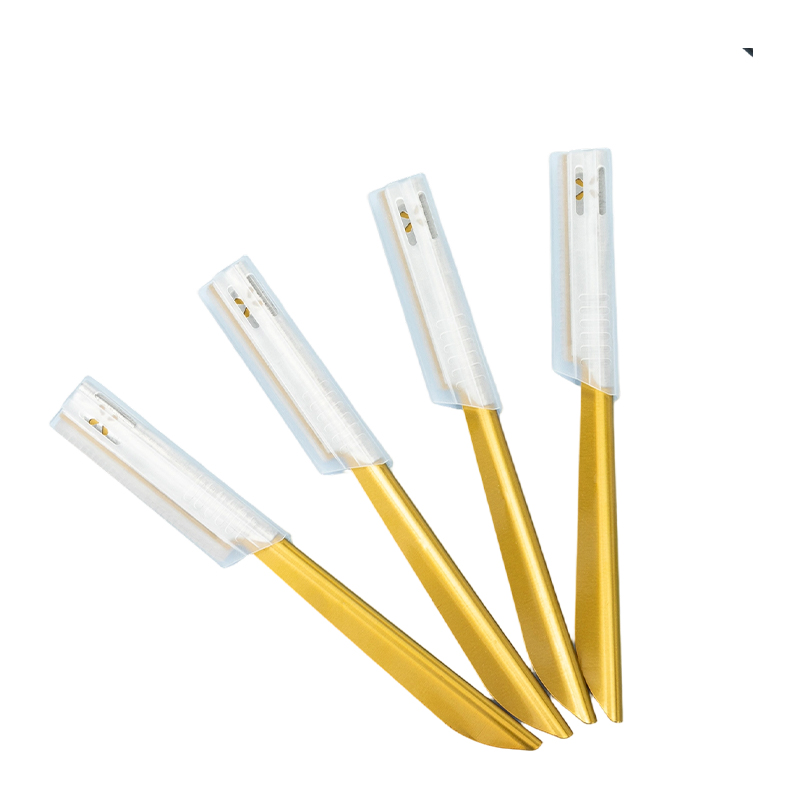
An eyebrow razor equipped with an imported premium steel blade delivers the cleanest line definition because the blade edge retains its sharpness through repeated strokes without dragging or snagging fine hairs. The difference between a precisely shaped brow and one with residual stubble or skin irritation often comes down to the blade material: high-carbon stainless steel with a Rockwell hardness above 56 HRC holds a finer edge angle, typically ground to 15 to 20 degrees, than commodity stainless blades that dull after a few uses and require increased pressure that nicks the skin. For both men and women, the right eyebrow razor is not a one-size-fits-all tool; it must match the user's facial contour, the density of the brow hair, and the specific grooming task, whether that is detailed shaping, full brow maintenance, or quick travel touch-ups.
Content
Blade Material and Edge Geometry
The blade is the functional heart of any eyebrow razor, and its metallurgy directly determines the shaving experience. Imported premium steel, typically sourced from Japanese, German, or Swedish mills, undergoes a controlled heat-treatment process that produces a fine, uniform carbide distribution within the martensitic steel matrix. This microstructure allows the blade to be sharpened to a keener edge without micro-chipping along the apex. The edge radius of a quality eyebrow razor blade measures in the range of 0.3 to 0.5 microns at the very tip, compared to 1 to 2 microns for a standard utility blade. This sub-micron edge slices through the hair shaft with minimal pulling force, which reduces the tactile sensation that triggers the skin's inflammatory response. The blade is often coated with a thin layer of PTFE or a ceramic-based coating that further reduces friction, allowing the blade to glide across the skin surface rather than skipping. This coating also provides a degree of corrosion protection, important because eyebrow razors are frequently used on skin that carries residual moisture, toner, or cleansing products.
Edge Retention and Replacement Indicators
A premium steel eyebrow razor blade maintains its cutting efficiency for 3 to 5 full grooming sessions under normal use, after which the edge gradually degrades. The degradation is not a catastrophic failure but a progressive rounding of the apex that increases the force required to cut a hair. The user perceives this as a tugging sensation or the need to pass over the same area multiple times. At this point, the blade should be replaced. Continuing to use a dulled blade risks two outcomes: the increased pressure abrades the stratum corneum, causing redness and flaking, and the blunt edge can catch and pluck hairs out by the root rather than shearing them cleanly, leading to folliculitis. Quality eyebrow razors are designed with replaceable blade cartridges or are priced as disposable units where the entire tool is replaced, so the user never needs to handle a bare blade during the changeover.
Razor Head Design and Facial Contour Adaptation
The effectiveness of an eyebrow razor depends as much on the head geometry as on the blade sharpness. The brow bone, the arch, and the area between the eyebrows present curved, sometimes concave surfaces that a straight, rigid razor head cannot follow. The solution is a combination of a small, angled head profile and a blade that is either segmented or has a micro-serrated safety guard that limits the depth of cut. The head width on a dedicated eyebrow razor is typically 8mm to 15mm, compared to 30mm or more on a full-face shaving razor. This narrow profile allows the user to work on individual rows of brow hairs without accidentally cutting into the surrounding arch shape. The angle between the blade edge and the handle is set at approximately 45 to 60 degrees, a geometry that allows the user to hold the handle comfortably while the blade contacts the skin at the optimal shaving plane without requiring an awkward wrist angle.
Men's vs. Women's Eyebrow Razor Design
While the fundamental cutting mechanism is identical, razors marketed primarily to women often incorporate a longer, more slender handle for precise control during detailed shaping, and the head may include a built-in brow comb or spoolie brush on the opposite end for brushing hairs into position before cutting. Razors designed for men's brow grooming typically feature a slightly wider blade and a handle with a more substantial grip diameter, reflecting the generally larger hand size and the tendency for men to use the tool for broader brow cleanup rather than intricate arch sculpting. Both designs, however, share the same imported steel blade core and the same edge protection features. The differentiation is ergonomic and aesthetic, not a difference in cutting quality.
Specialized Models Within the Eyebrow Razor Series
A complete eyebrow razor series addresses the full spectrum of user scenarios, from the daily bathroom counter tool to the compact travel companion. The variety is not about offering superficial choice; each variant solves a specific grooming context that a single do-it-all design cannot optimally address.
| Razor Type | Key Feature | Best Suited For |
|---|---|---|
| Precision Shaping Razor | Ultra-narrow 8mm head | Detailed arch definition, individual hair removal |
| Multi-Function Grooming Tool | Dual-ended with spoolie brush | Complete brow grooming in one tool |
| Travel-Friendly Compact Razor | Foldable or capped head, miniature size | On-the-go touch-ups, toiletry bag portability |
| Full Brow Razor | Wider 15mm blade with safety comb | Bulk hair removal between brows, unibrow cleanup |
Travel-Friendly and Portable Designs
A travel eyebrow razor must protect the blade edge from damage during transit and protect the user's fingers from the blade when reaching into a toiletry bag. The most effective travel designs incorporate a rigid, ventilated cap that snaps over the blade head and locks into place with a positive detent. The cap prevents the blade from contacting other items in the bag, which would dull the edge, and it allows any residual moisture to evaporate through the ventilation slots, preventing the corrosion that a sealed, damp environment promotes. Compact travel razors reduce the handle length to 80mm to 100mm overall, small enough to fit in a shirt pocket or the smallest compartment of a carry-on. Despite the reduced size, the blade itself is the same imported steel as the full-size version, so cutting performance is not compromised for portability.
Multi-Functional Grooming Tools
The multi-function eyebrow razor combines the cutting head with a second grooming element, most commonly a spoolie brush at the opposite end of the handle. The spoolie, a cylindrical brush with nylon bristles arranged in a spiral, combs the brow hairs upward and outward, separating them and revealing the natural brow line. The user brushes, assesses which hairs fall outside the desired shape, flips the tool, and shaves those specific hairs. This brush-and-shave sequence integrated into a single tool is faster and more precise than using two separate implements, particularly for daily maintenance where the goal is removing the few stray hairs that have grown since the last detailed shaping session. Other multi-function variants include an angled tweezers tip in place of the spoolie, allowing the user to pluck individual stubborn hairs that the razor cannot address because they lie flat against the skin or are too coarse to cut in a single pass.
Technique and Best Practices for Eyebrow Shaping
Even the finest razor cannot compensate for poor technique. The correct shaving sequence begins with clean, dry skin. Any oil, moisturizer, or makeup residue on the skin surface lubricates the hair shaft and allows it to deflect away from the blade edge rather than being captured and cut. A gentle cleanser removes this residue, and the skin is patted completely dry. The brow hairs are then brushed upward with a spoolie to expose their full length. The razor is held at a 30 to 40 degree angle to the skin surface, not perpendicular. Short, feather-light strokes of 3mm to 5mm in length are directed in the direction of hair growth, which for the brow area generally means outward toward the temple for the top of the brow and slightly downward for the area beneath the arch. Long, sweeping strokes are the primary cause of over-shaving accidents; they remove too much hair before the user can react to the changing brow shape. After each few strokes, the area is brushed again to reassess the shape. The shaved area should be rinsed with cool water and a fragrance-free soothing gel applied to calm any microscopic skin disruption.
Skin Preparation and Aftercare
The skin beneath and around the eyebrows is thinner than most facial skin, with a thinner dermis and fewer sebaceous glands. This fragility means it is more susceptible to razor burn and post-inflammatory hyperpigmentation if shaved aggressively. Applying a warm compress for 30 to 60 seconds before shaving softens the hair cuticle and opens the follicles slightly, reducing the cutting resistance. After shaving, an alcohol-free toner with soothing ingredients like aloe vera, chamomile extract, or panthenol reduces the stinging sensation and helps the microscopic nicks in the stratum corneum close and heal. Any product containing alpha-hydroxy acids or retinol should be avoided on the shaved area for at least 12 hours, as these exfoliating agents will penetrate the freshly compromised skin barrier and cause stinging, redness, and peeling.
Hygiene and Blade Longevity
The eyebrow razor contacts skin oils, microscopic skin flakes, and occasionally traces of blood from a minor nick. This organic residue, if left on the blade, provides a nutrient medium for bacterial growth and promotes corrosion of the steel edge. After each use, the blade should be rinsed under hot running water, shaken to remove excess moisture, and stored with the protective cap in place but not sealed airtight. Storing the razor in a shower caddy or a sealed, humid bathroom cabinet shortens blade life by promoting condensation corrosion. The blade should be replaced or the disposable razor discarded after the cutting feel changes from smooth to dragging. Continuing to use a razor past this point does not save money; it costs time in rework and risks the skin irritation that requires additional products to soothe. A well-maintained premium steel blade used on clean, dry skin can deliver 8 to 12 weeks of weekly grooming sessions before replacement, assuming the blade is protected from moisture and physical damage between uses.
Selecting the Right Eyebrow Razor for Your Grooming Routine
The choice of razor within the series depends on three user-specific factors: grooming frequency, brow density, and travel habits. A person who shapes their brows daily or every other day benefits from a precision razor with the narrowest head, because the maintenance task involves removing only a few newly emerged hairs, and the narrow head provides the control to target those hairs individually without disturbing the established brow shape. A person who grooms weekly or bi-weekly, and who faces a heavier regrowth between sessions, may prefer the full brow razor with the wider safety-comb head that clears the unibrow area and the brow perimeter efficiently, then switches to a precision tool for detail work. The frequent traveler should own a dedicated travel razor that stays packed in the toiletry kit, ensuring that a sharp, protected tool is always available and eliminating the risk of arriving at a destination only to discover the primary grooming tool was left on the bathroom counter at home.
Related Products
Looking for a Reliable Blade?
Work with a Manufacturer.
Inquiry Us Now

-
 +86-400 9915 887
 -
 +86-021-57644936
 -
 [email protected]
 -
 No. 2066, Yushu Road, Songjiang District, Shanghai, China
QUICK LINKS
 Home
HomePRODUCTS
QR CODE
Copyright © 2025 Shanghai Cloud Blade Manufacturing Co., Ltd. All rights reserved.
 Custom Double Razor Blade Factory
