

 ENG
ENG
 English
 Español
Message Feedback

Industry News
Apr 02,2026
Double Edge Razor Blades: Complete Buyer's Guide
Content
- 1 Why Double Edge Razor Blades Outperform Modern Cartridge Systems
- 2 Steel Quality: The Foundation of Every High-Performance Blade
- 3 Blade Coatings and Surface Treatments That Enhance Shaving Comfort
- 4 Sharpness Levels and How to Match Them to Your Shaving Needs
- 5 Customization Options for Professional and Bulk Buyers
- 6 Practical Tips for Getting the Most From Every Blade
Why Double Edge Razor Blades Outperform Modern Cartridge Systems
Double edge razor blades have maintained a loyal and growing user base across professional barbershops and personal grooming routines for one straightforward reason: they deliver a level of shaving precision, skin comfort, and cost efficiency that multi-blade cartridge systems fundamentally cannot replicate. Where cartridge razors stack multiple blades to create a single aggressive pass, a double edge blade exposes one finely honed edge at a controlled angle — reducing the number of times each hair follicle is cut below the skin surface and significantly decreasing the incidence of razor bumps, ingrown hairs, and post-shave irritation.
The mechanical simplicity of the double edge format also contributes to its performance advantage. With only a single blade between the razor head and the skin, the user has complete control over blade angle, applied pressure, and stroke direction — variables that experienced shavers use to navigate contoured facial areas, jawlines, and neck curves with a degree of accuracy that fixed-cartridge geometry prohibits. For barbers working across multiple clients daily, this control translates directly into service quality and client satisfaction. For personal users, it translates into a shave that is simultaneously closer and gentler than anything a cartridge system provides at any price point.
Steel Quality: The Foundation of Every High-Performance Blade
The single most important determinant of double edge razor blade performance is the quality of the steel from which the blade is manufactured. Premium imported steel — specifically high-carbon stainless steel alloyed with chromium, tungsten, and in some formulations vanadium — provides the combination of hardness, corrosion resistance, and edge retention that separates professional-grade blades from commodity alternatives. The chromium content, typically ranging from 13% to 16% in high-quality blade steel, forms a passive oxide layer on the blade surface that resists rust and oxidation during use, ensuring the edge remains sharp through multiple shaves rather than degrading rapidly after first contact with water and shaving product.
Carbon content plays an equally critical role in defining blade hardness and edge geometry. Higher carbon concentrations — combined with precision heat treatment during manufacturing — enable the steel to be ground to a finer, more acute edge angle without the metal deforming or rolling under shaving pressure. The result is a blade that cuts cleanly through hair with minimal drag, reducing the mechanical stress placed on skin during each stroke. Sourcing steel from established premium suppliers with consistent metallurgical specifications — rather than accepting variable-quality material — is what allows manufacturers to guarantee repeatable sharpness across production batches and deliver blades that meet the highest performance standards without variance.
Blade Coatings and Surface Treatments That Enhance Shaving Comfort
Beyond the steel substrate, the surface treatments applied to double edge razor blades after grinding are critical to shaving comfort and blade longevity. The most common and effective coatings used in high-quality blade production include platinum, chromium, and PTFE (polytetrafluoroethylene), each contributing distinct performance benefits that address different aspects of the shaving experience.
- Platinum coating adds a microscopically thin layer of corrosion-resistant metal over the steel edge, extending resistance to oxidation and providing a harder wearing surface that maintains sharpness across more shaving passes. Platinum-coated blades are typically positioned at the premium end of the market and are favored by users who prioritize longevity and edge consistency above all other factors.
- Chromium coating serves a similar corrosion-resistance function at a lower cost and is the standard coating applied to the majority of professionally manufactured blades. The chromium layer also contributes a degree of surface hardness that resists micro-chipping at the edge during use, preserving the smoothness of the cutting surface across the blade's functional lifespan.
- PTFE (Teflon) coating is applied as the outermost surface layer on many high-performance blades to reduce friction between the blade edge and skin. The hydrophobic, low-friction PTFE surface allows the blade to glide over the skin with minimal resistance, reducing the sensation of drag and heat that contributes to post-shave irritation, making PTFE-coated blades particularly suitable for users with sensitive skin.
Many premium double edge blades layer multiple coatings — chromium for hardness, platinum for corrosion resistance, and PTFE for glide — creating a composite surface treatment that addresses the full range of performance requirements simultaneously. The specific treatment combination a manufacturer chooses reflects their priorities in balancing sharpness, comfort, durability, and production cost within the blade's intended market position.
Sharpness Levels and How to Match Them to Your Shaving Needs
One of the most practically useful aspects of the double edge razor blade market is the genuine and measurable variation in sharpness across different blade specifications — a level of product differentiation that cartridge systems entirely fail to offer. Understanding this spectrum and selecting the appropriate sharpness level for your skin type, hair texture, and shaving technique is the key to optimizing comfort and results.
| Sharpness Level | Best Suited For | Hair Type | Recommended Experience Level |
|---|---|---|---|
| Mild / Forgiving | Sensitive skin, daily shavers | Fine to medium | Beginner to intermediate |
| Medium / Balanced | General use, most skin types | Medium to coarse | Intermediate |
| Sharp / Aggressive | Dense beards, professional barbershop use | Coarse, thick | Experienced / Professional |
| Ultra-Sharp | Straight-razor-style results, expert technique | Any — with correct angle control | Advanced / Professional barber |
Users transitioning from cartridge systems to double edge shaving frequently make the mistake of selecting the sharpest available blade immediately, assuming sharper always means better. In practice, a blade that is too sharp for an inexperienced technique or fine skin produces nicks and irritation rather than a clean, close shave. Starting with a medium-sharpness specification and adjusting based on direct experience is the consistently recommended approach for new adopters of the double edge format.
Customization Options for Professional and Bulk Buyers
For barbershop owners, grooming product distributors, and private label brands, the ability to customize double edge razor blades to exact specifications represents a significant commercial and product differentiation opportunity. Every blade in a professional product series can be tailored across multiple dimensions — from core material specification and blade thickness to coating type, edge geometry, and packaging format — allowing buyers to create a product that precisely fits their client base's preferences and their brand's quality positioning.
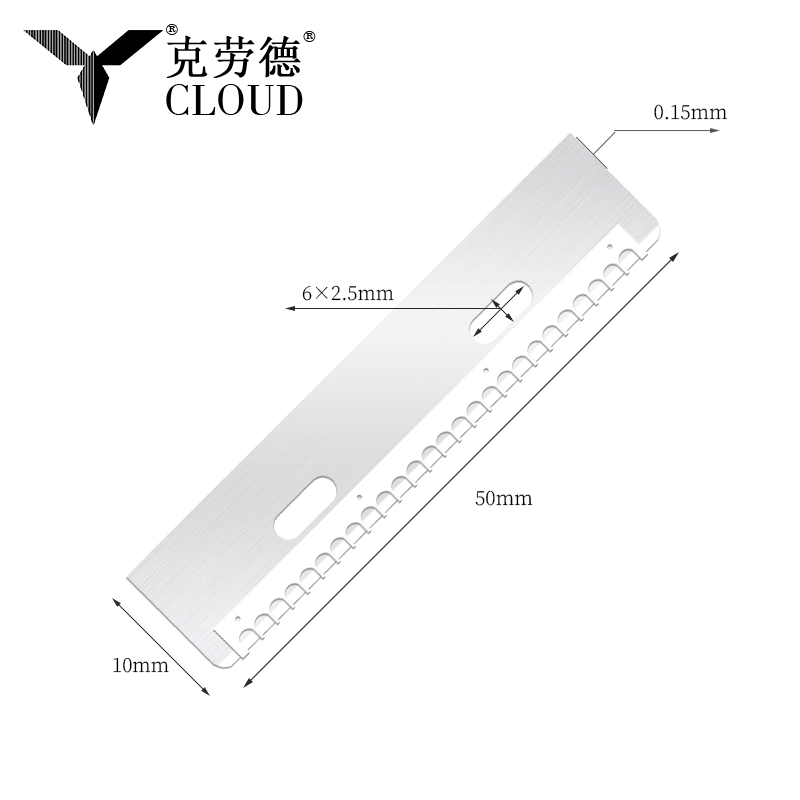
Blade thickness is one of the most impactful customization parameters. Thicker blades — typically 0.10 mm to 0.12 mm — provide greater rigidity during the shaving stroke, reducing blade flex and making them better suited to coarse hair and professional use where consistency across many consecutive shaves is required. Thinner blades offer more flex and a somewhat milder shaving feel, which certain users and applications prefer. Specifying exact blade thickness allows a buyer to target a specific position on the performance spectrum rather than accepting a manufacturer's standard compromise.
- Edge angle and bevel geometry: Customizing the primary bevel angle — the fundamental geometry that determines how aggressively the blade contacts the skin — allows manufacturers to create blades calibrated for specific razor head designs, ensuring optimal gap and exposure settings for the most popular safety razor models used by the target customer base.
- Coating stack specification: Buyers can specify single, double, or triple coating combinations — including chromium, platinum, and PTFE layers in selected sequences — to achieve a defined balance of sharpness, glide, and durability appropriate for their intended use case and price point.
- Wax paper and packaging format: Individual blade wax paper wrappers, dispenser boxes, bulk tuck packaging, and branded retail packs are all available as customizable options, enabling seamless integration of custom blades into existing product lines or new private label launches.
- Minimum order quantities and sampling programs: Professional buyers evaluating custom blade specifications benefit from sampling programs that allow sharpness, coating, and thickness variations to be tested against real-world use before committing to full production volumes — a practical safeguard that protects both product quality and customer satisfaction at scale.
Practical Tips for Getting the Most From Every Blade
Maximizing the performance and longevity of high-quality double edge razor blades depends as much on technique and aftercare as on blade specification. Even the sharpest, best-coated blade will underperform if used with incorrect angle, inadequate skin preparation, or improper post-shave storage.
- Maintain a consistent blade angle: The optimal shaving angle for most double edge razor designs is between 30° and 45° relative to the skin surface. Angles outside this range — either too flat or too steep — reduce cutting efficiency and increase skin abrasion regardless of blade sharpness.
- Use zero applied pressure: Unlike cartridge razors designed to compensate for poor technique with spring-loaded heads, double edge shaving requires the user to let the weight of the razor do the work. Applying downward pressure is the single most common cause of cuts and irritation among users transitioning from cartridge systems.
- Rinse and dry blades thoroughly after each use: Water remaining on the blade edge accelerates micro-corrosion and dulls the edge between shaves. Rinsing under hot water to remove soap residue, then stropping gently on a dry towel or allowing air drying in an upright razor stand, extends blade life by several additional shaves.
- Replace blades at the first sign of drag: A high-quality double edge blade used with correct technique should glide smoothly with no sensation of pulling. Any perception of drag or increased resistance is a reliable indicator that the edge has degraded and replacement will immediately restore shave quality — attempting to extend use beyond this point increases irritation without delivering meaningful cost savings.
Whether sourcing blades for a professional barbershop environment or selecting the right specification for daily personal use, the combination of premium imported steel, precision surface treatment, appropriate sharpness selection, and correct technique consistently delivers the smooth and precise shaving experience that has made the double edge format the enduring preference of the world's most discerning shavers.
Related Products
Looking for a Reliable Blade?
Work with a Manufacturer.
Inquiry Us Now

-
 +86-400 9915 887
 -
 +86-021-57644936
 -
 [email protected]
 -
 No. 2066, Yushu Road, Songjiang District, Shanghai, China
QUICK LINKS
 Home
HomePRODUCTS
QR CODE
Copyright © 2025 Shanghai Cloud Blade Manufacturing Co., Ltd. All rights reserved.
 Custom Double Razor Blade Factory
